A day in the life of a teacher

This is a story that answers the question – “How was your day?”  I often answer “it was fine” or “fun day with the kids!” because there a million different details, emotions, triumphs, and failures that occur each and every day.  This day, though, seemed like an extraordinarily normal day.

The day begins with me arriving to school at 7:20, already with a knot in my stomach because I am ten minutes behind my normal routine.  I need to put the final touches on my lessons and figure out what I’m going to do in my advisory class because, at the moment, I had nothing planned (not a good place to be in but something you become skilled at figuring out as a teacher).  

7:23

I walk into the school and before I even get to my classroom a coworker says, “Hey Casey, can you come take a look at this?”  He asks about my input on an awesome idea we’ve been developing since a district math PD from a few weeks back.  I give him the my two cents without giving away that I’m internally FREAKING OUT over the work I need to complete before the kids show up.  He doesn’t have a clue about my internal affairs but he’s awesome and the idea is awesome, so I stick around.  

7:30

I walk into my class to prepare for the day.  Quick – make the slides, write the objectives on board, and finish the opening question before the students…. “EYYY, MISTERRRRR” (first student enters at 7:39).  Do my best to have a conversation, help kids with homework, as well as finish planning before class starts.

1st Period

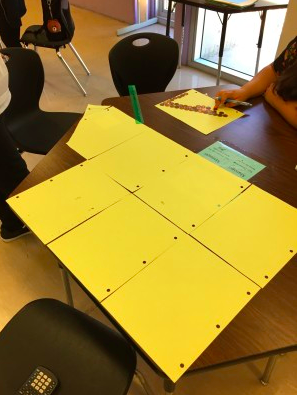
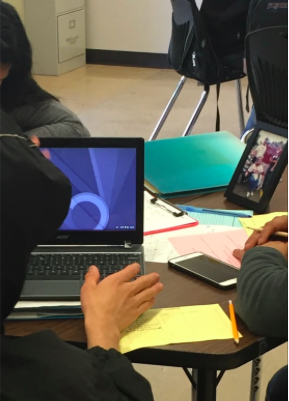
In my frantic rush before school, I made groups for the students to prepare for their upcoming test.  Of course, one student says “I’m not working with that group.”  I plead, I beg, I negotiate.  Nothing.  Okay, you win.  I change the groups slightly to make things work.  The groups work really well together!  Next thing I know, one student has ventured to my desk and finds a picture of me with my family.  “How old were you?”  “Is this your dad?” “Is this your brother?” “How old is your brother?” – you know, normal prepare-for-math-test questions.  After a moderately brief interview the students continue to work but decide my family should join them (see pic).  Class finishes up fairly well.  I feel good about the class.
Screen Shot 2018-02-28 at 6.13.40 PM
My family joins group for the math review.

2nd Period

Shit.  I’ve got one period to figure out what I’m doing for advisory.  Growth mindset – it’s my thing.  Let’s go with that.  I tell myself that I can create a lesson that will have to suffice for today, and I can always build on it in the future.  The knot in my stomach is back.  I watch a video and create an activity for kids that speak every level of English.  Magic! (or crap, depending on who you ask).  I run downstairs to print for advisory and find that my planning partner has printed the documents I need for the next day (thank the Lord).  I run back to class, proud that I was able completely avoid a panic attack and produce something of value.

3rd Period

The bell rings.  The phone rings.  “Mr. Casey, I’m just calling to let you know class C (the class about to come to me) might be a little late because they all worked so hard I gave them all Huskies!” Huskies are little statements of accomplishments when kids are caught doing great things.  I’m super excited.  Let’s keep this positive day alive!

FIRE ALARM GOES OFF.

SHITSHITSHITSHITSHITSHITSHITSHITSHIT.

I don’t even have all of my kids in my class yet.  Why is the alarm going off between classes?  Did someone pull the alarm?  Is this like Parkland, Florida? Dumb thought.  Is it a dumb thought?  Let’s get all my kids to my room, then go outside.  COME ON KIDS!!!  Okay, everybody outside.  I don’t have my green paper (to hold up when I know all the kids are with me).  Who cares.  Let’s go.  Student crying in the stairwell.  “Are you okay?”  We still need to go outside.  “No, mister”.  “I want to hear you but we need to go outside”.  We go outside.

My students are all scattered at this point and I try my best to wrangle them in.  “Mister, do you think mutations are good for humans or bad?”  “What?”  The student asks again.  “This is not the time to ask me that question”.  Student 1 hits coca-cola out of student 2’s hand and laughs.  We get the go-ahead to head back into the school.

Class C – the class that was just previously ALL awarded Huskies – now resemble that of an unsupervised 3rd grade recess in my classroom.  I decide it’s time for meditation.  “We are going to try to refocus.  You can copy down the opening, you can put your heads down and sleep, but lets be quiet and try to focus.  Let’s take three minutes.”  We take 6 minutes because I’m putting out four different dumpster fires happening all at once.  (I’m actually quite proud of 6 minutes).

We finally start class, kids complain about groups but mostly work pretty well together!  Granted, they didn’t finish nearly as much because so much time was lost to the fire alarm.  Bell rings.  Success!  Then I notice a protractor glued to the table with whiteout. Great.  “Who did this?”

4th period – Advisory

My already rushed, under-prepared advisory lesson began by the two culprits of the whiteout fiasco cleaning up one of the tables.  Although it was rather distracting to start class I felt this small ounce of pride in making students repair the damage they caused.  Advisory continues.  It goes fine.  Not the lesson of the year, but I’ve taught worse lessons.

Lunch

12:05 I hold one student back because I notice that he has not been getting along with another student who is in his math class and in our advisory.  He gives his side of the story.  I listen and try to give him feedback.  We come up with some positive actions steps which includes me touching base with the other student.

12:12 I get 15 minutes of peace.  Pretty sure I just ate my PB&J quietly and stared at a wall.

12:27 A student walks in that NEVER comes in to lunch.  Actually he is usually absent a handful of times during the week.  He comes in and we chat about life for about 15 minutes.

12: 42  Another student comes in early to class (class starts in 8 minutes).  This student is newer to the school and has very limited English at the moment.  I introduce the students and start to clean up the room and get ready for the next class.  I overhear the first student telling the second how important it is to try hard and that if you want to learn, you will.  If you don’t try, then you’re not going to learn.  My heart swells just writing about it. SO AWESOME

5th period

Bell rings and students show up.  A student shows up and makes a game out of trying to throw oranges into a cardboard box.  Orangeball?  I give him a look, he makes the orange in the box and gives me an I-told-you-so look.  Another student comes running into class dripping sweat and grabs some napkins.  Students get to work quickly!

Another student – usually absent from my 1st period class – shows up in my 5th period class.  He’s kind of distracting but he is being quite respectful just trying to get to know other students.  “What class are you supposed to be in?”  “It doesn’t matter.”  I check the schedule and give his teacher a call.  “He’s supposed to be in the office.”  Ah.  That explains it.  I call the office to let them know.  I pull up a chair and have him work with a group until the AP shows up. “I wasn’t even distracting anyone!”  A part of me is sad because he was engaging well with students but I owe it to his teacher and whoever he was disrespecting that there was follow through.

Class is working so well I change my lesson plans and let them continue to work together and teach each other until the end of class.  I gave out a Huskie to the other teacher in the room and tell everyone to write a Huskie for someone in their group because they worked so hard!

6th Period

Class starts fairly quickly.  I note that when the bell rang there was only one opening out (showing they are ready to start class).  A student leader starts class, another randomly yells nonsense.  Take a minute break, dude.  The other teacher in the class tells me the teacher across the hall is also in the hallway taking a breather – that kind of day.

Mister, I want to take my test.  Mister, I want to check my grades.  Mister, is this right?  I pause the class and tell them how great they are at asking questions and being aware of what they need but terrible at timing.  I get the classes started.  Some work better than others but overall it felt, meh to good-meh.

End of the day

Take attendance, start looking at tomorrow, look at and respond to emails, clean up the classroom.  I try to get out of school early around 4:30 because I have tutoring at 7PM where near where I live, 45 minutes away, and a good chunk of papers to grade waiting for me at home.

How was my day?  It was fine.
Plan, Do, Study, Act to Improve Classroom Routines

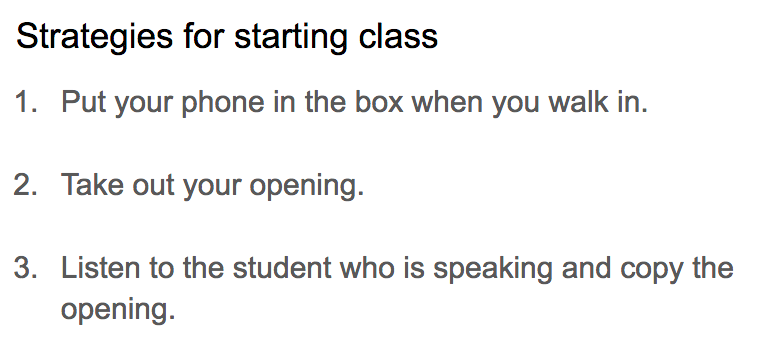
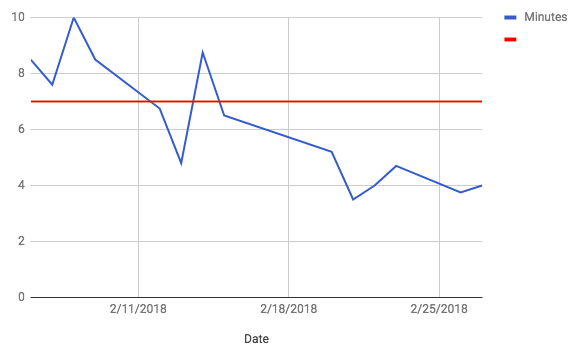
Recently, my last period class fell into a habit of struggling to get started each day.  One day, when it took the class ten minutes, I was finally fed up with yelling at students to sit down and get started.  Instead, I asked them “how much time do you need to get started?”  We defined “getting started” as sitting down with the opening out, phones put away, and a student leader starting class.

Student proposals ranged from 3 minutes to 10 minutes and we finally settled on the categories of 3, 5, or 7 minutes.  Three students gave their passionate explanations of why 3 or 5 or 7 were the best for the class (I personally was a fan of the 3 minute speech).  I should have known better than to let the 7-minute delegate talk last but, sure enough, the class voted for 7 minutes.  Fine.  At least it’s better than 10 minutes.

Screen Shot 2018-02-27 at 8.00.58 PM

The first days seemed to go better and they even were able to reach their goal twice.  Then, another bad day set in.  The problem I identified was that the group had set a goal but had not defined any strategies to meet the goal.  What did they need to improve?  Again, after a debate with the class we settled on the following strategies.

Screen Shot 2018-02-27 at 8.03.12 PM

Since that date the time it has taken to start class has continued to decline.  It began to level off at about four minutes this week which I think is a much more reasonable amount of time and similar to the other classes I have throughout the day.  I am now going to start keeping track of how well students follow through with their strategies and maybe we’ll see it decline even more!  Either way, I’m proud of their improvement!

Empowering students to learn as a group

One of my favorite things about working at my new school is they way in which students are encouraged to learn together.  In fact, it isn’t just encouraged; it is how learning happens in every class.

A strategy that my planning partner and I use regularly is the explanation quiz.  It is basically a task designed to help students explore a concept and work together to understand the concept.  Here are a couple of the main things needed to make it run smoothly:

1.  Every student in the group needs a role.

The four roles I use are:

(1) Group manager – in charge of checking understanding and process checking,
(2) Task manager – in charge of making sure that everyone understands what the task is and is participating,
(3) Communications manager – in charge of sharing ideas with the class and making sure ideas and voice within the group are equitable, and
(4) Resource manager – in charge of making sure the group has supplies and in charge of relaying questions to the teacher.

2.  Students should be aware of expected group norms and “ways to be smart”.

These are some of our norms:

  • Everyone needs to understand
  • Same question, same time
  • Talk first, then write
  • Group questions only
  • Group talk only

These are some of the ways I say students can “be smart”:Screen Shot 2018-01-20 at 5.07.29 PM

  • Papers in the middle of the table
  • Pointing
  • Leaning in
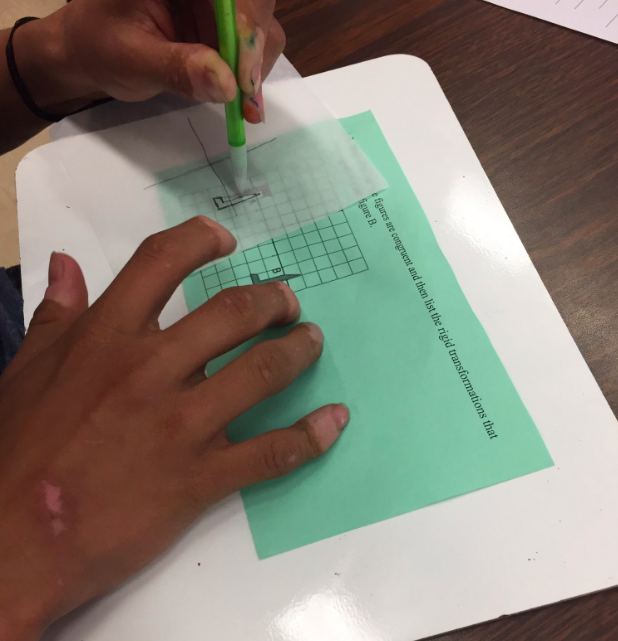
  • Using ________ (whiteboard, protractor, patty paper, desmos, translator, etc.)

3. Students need to get feedback on their work.

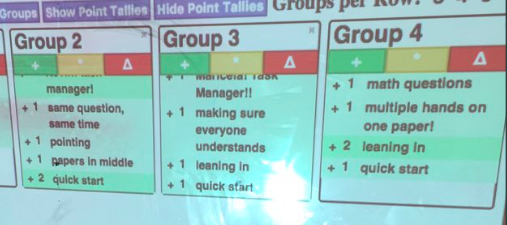
My favorite new tool of the school year is http://mrpinsky.github.io/.  It is simple to use and allows you to document the way students are doing well or not doing well.  You can give points to students that are doing good work and comment on it out loud saying, “I like how group 3 is leaning in and Marcos is helping make sure everyone in his group understands”.  Students pay attention to this and start to mimic the work.  Often, students will say “Mister, we are leaning in, why didn’t you give us points?”  Likewise, you can type “phones out” without saying anything and a student on their phone will quickly be scolded by their group mates.

Screen Shot 2018-01-20 at 4.50.16 PM


4. Space to work.

One of the most difficult things for me as a teacher this year was to learn to get out of the way.  When you create a classroom system that encourages students to work together you need to give them space to do it.  It is okay to step back and let them work; in fact, it is the best way to let them thrive.  The goal is for groups to use each other and be in charge of advocating for help only after they have consulted each other.  One easy way to do this is to limit the number of questions a group can ask the teacher (I usually do a 2 questions limit that works well).

With all that being said, the amount to which students are equitably accessing the content and learning remains my main focus this semester.  I wonder what other structures I can give groups to improve the amount students can learn together, and I’m trying to find that sweet spot between helping groups and letting them work without me.  Please share these resources with teachers you know and let me know if you’ve found other methods that help engage students in collaboration!

Shout out to my planning partner https://twitter.com/SergtPeppa.

Modeling perfect answer is not modeling perfect learning

Last week a student of mine was curious about the quadratic formula.  He had seen it before but didn’t understand why we used it.  “Where does it come from?”, he asked.

I loved this question.

I did the thing any excited math teacher would do and decided to take a couple of minutes to explain to him how we can start with ax^2 +bx + c = 0 and complete the square.  Luckily, this took place after school because five minutes quickly turned into twenty and soon he said “sorry, mister, I need to run!”  Even though it was a concept that I understood and I have taught before, I ran into bump after bump and I found myself thinking collaboratively with my student about the problem but ran out of time and couldn’t quite figure it out in time!

Luckily, I didn’t feel too defeated because I figured it out a few moments after he left, but it got me thinking…  Often as a teacher, I feel the need to be fully prepared – down to the last detail.  I feel like any example I show or any question that I answer must be done to perfection.  And yet, learning is the exact opposite.  Learning is messy and bumpy.

If I would have prepared a lesson and taught the quadratic formula explanation perfectly by detailing every step would more learning have occurred?  What is the value of modeling a perfectly solved problem?  Would it be more meaningful to model good questioning and struggle through a problem?  How do we let students solve questions like that while still allowing them the support to access it?

I don’t know the answer to it all, but definitely some questions worth grappling with.  Curious if you have thoughts or similar situations to this!

Understanding the Importance of Fixed Mindset

Screen Shot 2017-07-13 at 4.57.57 PMNow that grad school has finished up, I have more time to reflect on the multitude of great experiences that took place over the last year.  One of the best fanboy moments came when I was able to meet with Carol Dweck.  I was working on a curriculum centered around growth mindset and my teammate and I were lucky enough to get 30 minutes to bounce ideas off of the celebrity known as Dweck.

My main take away from the meeting was that mindset is much more complex than many educators portray it to be.  For example, the talking points around growth mindset tend to be “growth mindset is good” and “fixed mindset is bad”.  As teachers, we emphasize the importance of developing a growth mindset and communicate they need to have the proper mindset in order to find success.

Walking away from my meeting with Dweck, I realize that fixed mindset gets a bad rap.  She explained that fixed mindset isn’t this awful thing that we need to get rid of at all costs; instead, she talked about how fixed mindset is your mind’s natural reaction to new and challenging situations.  It is your mind’s natural defense mechanism.  By asking students to get rid of a fixed mindset we are asking them to become inhuman and ignore their body’s natural reactions.

Instead, she proposes teaching students to become aware of the moments in which fixed mindset presents itself.  “Give a name to your fixed mindset”, she said.  Recognize that it is a part of you and when it shows up, acknowledge it by name and thank it for trying to protect you.  Tell it that you need to push past that uncomfortable feeling for the moment because there is an opportunity to grow.

As an example, I named my fixed mindset Jeremiah.  I was at IKEA earlier this week.  My first time there. Guys.  It’s super overwhelming.  I’m a small town boy and this building was bigger than my town.  I wandered my way around and finally got to the nightstand/ dresser section, which is what I was looking for.  I was finally there, and I didn’t know how I was supposed to buy the items I really wanted.  I snapped my friends, telling them how dumb IKEA was and seriously considered just leaving and going to Target.  I was overwhelmed and didn’t know what to do.  I was sweating.

I didn’t know it in the moment, but these are the feelings that arise when fixed mindset is afoot:  stress, being overwhelmed, anxiety, frustration.  I didn’t know my way around the store and rather than asking an employee and risking looking stupid I kept to myself for WAY too long.  Finally, I went up to an employee and asked “I’m so confused.  How do I buy a dresser?”.  I hadn’t formally acknowledged Jeremiah, but I did finally decide that to figure this out I needed to risk looking stupid to learn how to buy the furniture I needed.  In the end, they explained it to me and, sure enough, now I know how to buy furniture from IKEA (yay me!)

So next time you talk to students about growth and fixed mindset, don’t hate on fixed mindset.  Instead, have students give their fixed mindset a name and help them become more aware of the moments fixed mindset arises in their life.  You can always start with yourself.  When do you find yourself getting defensive or upset?  Is your body just trying to protect you from failure and/ or looking stupid?  Once you become aware of the moments your mindset is fixed, it’s easier to consciously alter them into moments of growth.

Learning is Hard

One dark evening a man was on his hands and knees under a street light looking through the grass.
A pedestrian asked what he was looking for.
“The keys to my car.” replied the man.
Having some time and feeling helpful, the pedestrian joined the man in his search.
After a while, with no success, the pedestrian asked: “Where were you when you lost your keys?”
“Over there by my car.” the man gestured.
The pedestrian was puzzled. “Why are you looking for them here?”
The man without keys explained: “The light’s better!”

Why is it in education that we continually look for answers in the wrong place?

We give homework, tests, and assignments then grade students on their work.  When they don’t measure up to our expectations we encourage them to develop better habits and we talk to parents, then we move on to the next unit.  We decide the trouble lies somewhere in the work ethic of the student, the lack of support from home, or the general difficulty the student has “doing school”.

We shine the light on their ability to follow our rules and search for remedies that will allow the student to get “back on track”, neglecting the complexity that is human life.  Rather than meaningfully understanding the needs of students and responding to them, we focus on the limited time we have with students in class and expect them to figure out what they need to improve on their own.  

We seldom look for ways to deeply understand and connect with students and the ways in which they learn.  Once they are beyond the door of our classroom, it’s on them to do the learning, and if they can’t handle it, it’s their own fault.  Why is this the case?

Learning is hard.

True learning is hard and messy and takes a lot of time.  Honestly, thinking about a hypothetical classroom in which my most struggling students receive A’s gives me a panic attack because of the chaos, coordination, and deep focus it would take for me to help them find success.  The same can be true about searching for keys in the dark: it can seem impossible, but if that’s where you need to focus your attention, it appears to be a waste looking anywhere else.

I’m not arguing that it is the job of the teacher to do everything for students.  I’m simply arguing that giving them a C on a paper with comments is not enough for a student to do better on the next paper.  Earning a D on a math test and saying “you need to study harder next time” doesn’t help a student prepare for the next test.

I don’t have an answer to this dilemma, but I think it is important to admit just how difficult learning actually is and take one step toward embracing the messiness that is teaching.  It is time to stop looking at test scores and expecting students will change on their own.  It is time to stop looking under the street light and expecting we will find our keys.


Choosing Whichever Comes Last

We’ve all heard the commercial.  Buy a new vehicle and get some kind of 10 year/ 100,000 mile warranty.  When I was younger, I remember being curious about how it can be both 10 years and 100,000 miles under warranty only to find out that the warranty is covered until whichever happens first.  This makes sense for a business model, but I find this idea of “whichever comes first” creeps into our daily decision making and causes many of us to stop short of our true potential.

These thoughts came to me during a run.  I was out for a quick run and I told myself I was going to run for three songs then turn back around.  As the third song ended, I looked ahead and saw a side road about a quarter mile ahead.  I had the option to reach my goal of running for three songs or to push on for just a bit more.  I chose the latter.

The first issue many people face in reaching their potential is not setting a goal.  It is very unlikely to grow or even feel accomplished if you don’t have a goal in mind.  The second issue is that often people are satisfied with reaching their goal and, once they reach it, stay stagnant.

When given the option of 10 years or 100,000 miles I challenge you to choose whichever comes last.  Run to the next street, then one hill more, then finish that song.  Get your degree, get the job that you’ve dreamed of, but don’t ever stop striving for the next step.  You are bound to fail or come up short sometimes, but its the only way you know you gave it your all.  Learn from it, and get after it again.  Goals are great motivators, but they are just the beginning.  Greatness in school, in work, in relationships, and in life happen when you’re given two options and you choose whichever comes last and whichever takes the most work, reflecting on your journey and constantly preparing for the next challenge.

A Simple Switch Creates Curiosity

How often have you heard this in a meeting with your department, a parent, or even in your own head:

“Kids are too dependent on calculators!  They can’t do anything in their head any more!

There are countless examples of 17 year old kids not being able to complete simple arithmetic which is distressing, but it is not the argument I am here to make.

Instead, I am concerned the fear of calculator dependence is negatively affecting the way teachers design lessons, structure discussion, and assess their students.  When that fear is in the forefront of our minds, we ask students to put the calculators away.  “We need to understand how to do this by hand before we use the calculators”, you might say.  I ask WHY?

Living in the 21st century, we have technology all around us and if I want to know the answer to something I am going to google it.  If the calculator can do the problem for us, why are we wasting our time?  Maybe you argue you have to understand the process to really get what’s going on.  Okay.  My argument becomes: make a question that demands I understand the process.

I am not arguing that understanding how to complete a problem by hand is a bad thing; instead, I’m arguing it’s a great thing!  But we need to make students feel the need to understand.  We need to show that the calculator can calculate, but only humans can think, dig deep, and discover connections.  We need to design problems where the calculator can’t solve it in one step or at all so it once again becomes a tool in the learning process rather than the process itself.


To make my point, I will use the example of a lesson devoted to adding and multiplying 2×2 matrices.

Method 1

  • Give students an example of two matrices adding together, then work on the problem with them and show them how it is done.  Leave time for questions.  Then give them a few problems to try before moving on.  Pause for questions.
  • Now give students an example of two matrices multiplying together.  Don’t forget to warn them that this one is tricky!  Then, go through the process with them and take questions.  Then give them a few problems to try and walk around to help answer questions.
  • Two days later, show them how to complete it on the calculator.

Method 2

  • Show students how to add two matrices together using the calculator.  Have them figure out the pattern. Takes about 1 minute.
  • Show students how to multiply two matrices together using the calculator.  Have them figure out the pattern.  Takes very long.  Eventually after giving some hints and gentle nudging, students (maybe not all of them) figure out the pattern and share it.  Without discussing right or wrong, put up examples for students to try by hand and then check them with the calculators.


An amazing thing happens in method 2.  Students begin to view the challenge as a puzzle to figure out rather than an “enter” button to be pressed for an answer.  If you pause long enough after kids first type the multiplication into the calculator someone will ask, “why does that work?”. THAT’S LIKE NEVER ASKED!! YOU WANT TO KNOW WHY?!?  It’s a cool feeling.

Even though we allowed the students an opportunity to struggle, we have to wonder what motivation students have to remember the meaning of a topic and how to complete it by hand.  Why can’t they just go back to using their calculator?  The truth is, they can….if you design problems with simple answers. (Assume these are 2 x 2 matrices below being multiplied)

Easy With Calculator

[  1    2 ]      [ -2   4 ]
[  7   -4 ]      [  0   8 ]         =     ?

Not Easy With Calculator

[ 2     4]       [3      x]                [4      12]
[ 1     1]       [-1    6]        =       [14    9 ]


A slight change in thinking renders the calculator powerless or, at most, a guess and check monster that drags out the process.  Instead of fearing the power of a calculator, we need to make kids jealous of the power it has and push them to ask why and how it works!  If we can do that, while creating challenging questions that force students to think deeply, we won’t have to let the fear of calculators cloud our judgement.  A simple switch can lead to more curiosity, discovery, and understanding for students.

The Struggle of Letting Them Struggle

Today I was teaching an honors level class how to add and subtract rational expressions.  These are the students that have pushed themselves to take Algebra 2 over the summer to advance their potential opportunities as they become upperclassmen.  We’re talking serious students.

To begin the unit, I modeled my teaching after a Dan Meyer inspired idea and, although, not the most exciting thing, it helped students gain a little buy-in.  The previous day we had actually looked at adding fractions, discussed the similarities and differences of adding rational numbers and made significant progress.  So I thought.

We started today by checking over the homework and there were a lot of questions.  THERE SHOULD BE  A LOT OF QUESTIONS.  This is hard stuff and I was fortunate to have curious students, anxious to learn the content at a deep level and ask about their confusion.  If there aren’t any questions after the first day please don’t assume they’re good.  In fact, I could sense the frustration and kept telling them:

This is hard, but that’s why it’s better than many of the other things we look at.  It’s a chance for you to struggle and flex your creativity in solving problems.  Keep trying, keep failing, and keep asking questions.

Instead of moving on, I asked them if they would prefer to practice this a little more; they said yes.  I started by giving them a more simple problem.  Then, I increased the level of difficulty, and finally, gave them this harder problem:

__5__  +         4         –      2  
x(x+2)         -x – 2             5x

The students were able to handle the first two problems fairly well with asking only a few questions.  The final question pushed many of them outside of their comfort zone.  I let the students begin on their own, then as they began to ask questions I went in to help clarify some confusion.  But….it was rough.  I’m talking seriously rough.  Like, why would you do that, how can you even think that after the other things we looked at rough.

What I found myself doing as they asked me questions was becoming overwhelmed.  Student after student asked me questions, and I was having the most difficult time thinking about how to steer them in the right direction without showing them exactly how to do it.  At one point, I told a student:

Just hang on for a minute; I’m going to go through it with the class in a little bit.

It was at this point I realized the struggle of letting kids struggle.  Learning is messy, but when we have a quality problem of difficulty and students ambitious enough to struggle through it, we must ask ourselves whether we are ambitious enough to help them through the struggle rather than re-gain control and show them how it is done step-by-step.

As teachers, we need ways to encourage kids to take risks, while demonstrating that it is okay to do so.  We need to allow kids to make mistakes and fail, but we cannot be there to catch them as soon as it gets a little difficult.  Instead, we need to foster a classroom where creativity is encouraged and wrong answers are explored and shared.  In that moment, I wonder how the learning in my classroom would have changed if I grabbed three students’ notebooks, threw them under the document camera and, as a class, we discussed the math (wrong or right) that the student displayed.

I, like many other teachers, get caught up on the right answer rather than the process of getting there.  Because of this, I get frustrated when students are nowhere near the correct answer.  Instead, we need to embrace the messy process and the learning that is held within.  Maybe the student that struggled and got a problem wrong three times actually ends up learning and understanding the process at a deeper level than the student that got it right on the first attempt.

I ask you to be careful next time you get frustrated because no one in your class is finding the right answer.  Use the opportunity to talk about mistakes and continue to give them chances to flex their creativity and make mistakes.  It’s a struggle.