A More Hopeful Tomorrow

In a quiet corner of a classroom, a teacher sits in tears. She is carrying the weight of a story that has become far too common: a father of a student, a man who lived for his daughter’s future, was detained by ICE. He was disappeared from the life he helped build for his daughter.

Today, this is the reality in Saint Paul. We see it when American citizens feel the need to carry passports to the grocery store, as if their own skin isn’t enough proof of their belonging. We see it in the empty desks of students whose parents have decided that the safety of four walls is better than the risk of a school bus. And we hear it most clearly in the voice of a child who, when asked about a birthday celebration, simply says, “We cannot do anything because of immigration.”

When a child views “immigration” not as a civics lesson, but as the reason her birthday cake stays unlit, we have to ask ourselves: Is this the community we promised to build?

While some choose to spend their time denigrating our neighbors, I still find myself holding onto hope. I see it in organizations that have served immigrants long before the current crises – like COPAL and Unidos. Hope in the solidarity of educators demanding action and who refuse to let their students feel alone. And the hope of young people themselves, willing to organize, educate, and advocate for change. Hope, after all, isn’t a lottery ticket we hold; it’s the muscle we build by standing together.

people walking on gray concrete road during daytime

The Dissonance of Our District

But hope requires more than individual courage; it requires institutional integrity. I work for Saint Paul Public Schools—a district that tells the world:

At Saint Paul Public Schools (SPPS), our mission is both bold and simple: to inspire students to think critically, pursue their dreams and change the world.

Yet, right now, there is a painful dissonance between those words and our actions. When a group of high schoolers—the very young people we’ve told to “change the world”—organized a training to help their neighbors understand their constitutional rights, they were told by the district it was not allowed.

We cannot tell our students to be leaders on Monday and then punish their leadership on Tuesday. I don’t write this to cast blame, but to highlight a systemic failure. When we work in silos, when we let fear or bureaucracy dictate our response to a crisis of the soul, we fail the very families who trust us.

Beyond the moral dissonance lies a cold, fiscal reality. In Minnesota, school funding follows the student. Every time a desk sits empty because a family is too afraid to cross the threshold of a school, the district loses the vital state aid required to keep our doors open. By failing to prioritize our immigrant students, we aren’t just losing our soul—we are effectively de-funding our own classrooms.

To bridge this gap, we must move from reactive despair to proactive infrastructure. Here is the road map for a district that leads:

1. Form a standing committee dedicated to serving immigrant families.

We have incredible people across this district—teachers, counselors, social workers, and organizers—who are doing the work of a dozen people each. Currently, immigrant support is treated as a niche issue, leaving educators to carry the emotional and logistical labor in isolation. We need to form a standing committee with folks from across the district who are dedicated to serving our immigrant families. When we unify our resources and share the emotional labor, we don’t just work more efficiently; we remind every educator that they aren’t carrying this weight alone.

2. Codify a policy of belonging.

Our Superintendent, Dr. Stanley, has spoken often about the power of belonging, but our attendance policies were built for a low-risk environment. Currently, our policies effectively punish families for their own victimization. We must implement Inclusive Attendance Reform, moving away from automatic “drops” for students forced into the shadows. If we don’t decouple physical presence from enrollment status during times of crisis, we are incentivizing families to leave the district entirely. Inclusive Attendance Reform is more than a gesture of kindness; it is a retention strategy that ensures SPPS remains the district of choice for our city’s diverse population.

Whether it’s through adaptive attendance reform or the “Sanctuary School” model of creative communication and understanding, our message must be clear: Your seat is still here. You are still one of us.

3. Create more alternative education opportunities for immigrant students.

As a math teacher, I’ve experienced the challenge that arises when a student misses weeks of instruction. It’s a mountain that feels impossible to climb. But we are an innovative district. Let’s use that innovation to create alternative pathways for students who are afraid to leave their homes. This isn’t about “remedial” work; it’s about providing high-level, critical thinking opportunities that meet students where they are—ensuring that a crisis of safety doesn’t become a crisis of opportunity.

4. Create dedicated space in the Online School for immigrant students.

We have the tools. We have the Online School. Let’s use them strategically to build a robust, high-quality digital space specifically designed for those for whom the physical classroom has become a place of anxiety. By expanding its reach and staffing it with educators adept at serving immigrant families and using technology to bridge cultural divides, we create a high-quality “Public Option” for education that is decoupled from the physical risks of the street—a beacon available for students across the entire state.

The Call to Lead

The way we overcome despair is by building a community that is as organized as the forces that seek to tear it apart. We are not asking SPPS to do something new; we are asking it to be who it says it is.

I encourage our leaders—both in the boardrooms and the classrooms—to work together, and if you are an educator, a parent, or a neighbor, share this and ask your school or Board leadership: What is our plan for the desks that sit empty today?

Let us create a district and community grounded in the realities of today and the vision of a more hopeful tomorrow.

Note: This blog post was written in full by myself and then adapted based on editorial assistance using Google Gemini.

Clear Expectations and Direct Feedback

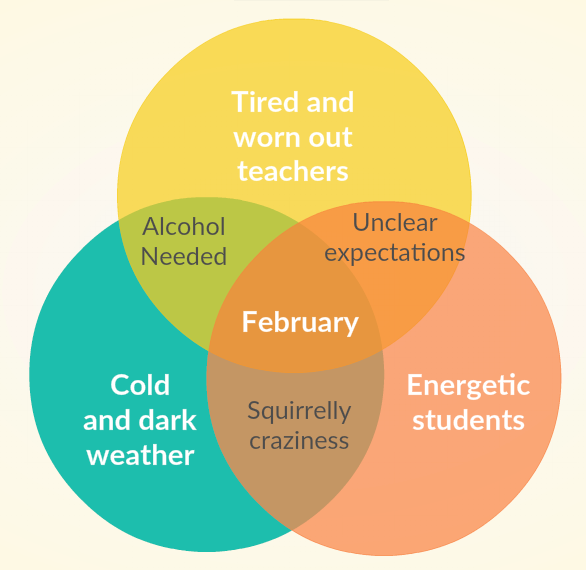
February is has always been a difficult month for me.  It always has been, and I predict it always will be (at least in the current system as a teacher).  It is cold; it is dark; it is that perfect sweet spot where the beginning-of-the-year expectations have seemed to be forgotten, energy is drained, and the end of the school year is too far away to smell hints of its sweet release.

Screen Shot 2019-02-16 at 7.31.54 AM

Although, I probably could write about the coping strategies needed to get through these difficult weeks, I’d prefer to share something I’ve been thinking about in regards to classroom expectations during this time.

For framing, this past week was one of the more difficult weeks of the school year.  A 1st period class was nearly empty one day, one third of another class was consistently late to each day this week, and larger relationship issues between students and between individuals and myself seemed to escalate to more than the normal level.

As a teacher, it is easy to get angry at students.  They are late, they are playing, they are misbehaving, and they don’t seem to want to give any respect to me or the other students in the class that are on-time and prepared, ready to learn.  I tried all the stages of “pre-anger” as I’ll call it:

Screen Shot 2019-02-17 at 9.33.10 AM

These are my go-to moves, but they just weren’t really addressing the root cause of why these students consistently were having trouble following these expectations.  Sure, kids had bad days and needed to check-in about big things happening in their life, but it was clear that the problem was larger than that.  It was a good chunk of students in a good chunk of my classes. I’m not a fan of blaming the kids or writing them off as “lazy” or “unmotivated” or even using the crazy things that are going on in their life as an excuse.  Instead, I looked inward at the ways in which I set clear expectations in my classroom and communicated my needs with students.

To help frame my thinking, I reflected on some work I studied from David Bradford, a researcher and professor in the business school at Stanford University.  Bradford talks about the deep need for clear feedback on behaviors.

“All feedback is positive if it is regarding behavior because we can change our behavior.” (Bradford, 2017).

Bradford writes about the interpersonal cycle in which between two people there are actually three sets of realities.  First, the reality of person A, who has their own needs and personal motivations; second, the behavior by person A which is a shared reality between the two people; and third, the reality of person B who receives, interprets, and responds to the action.  It is important here to note that the intent of person A can often have a different effect what was intended.  Without direct and clear communication and feedback person B is left guessing.

“When we don’t know why the other acts the way they do, we start to guess. This is a natural tendency because we want to have some sense of how the other person might act. We believe that if we understand motivation that it will reduce future uncertainty. (Bradford, 2017).

(Bradford, 2017)
(Bradford, 2017)

Based on these thoughts, I’ve been thinking about the ways in which I present myself as person A.  In teaching, I have my motives of encouraging all students to learn English (I teach emerging multi-lingual students) and math.  I have the needs of sleep and more time, often worn from meetings and other responsibilities held as a teacher-leader.  And, I have the situations of tardy students, students talking over other students, and the larger issues of support I face each day in my classroom.

In my mind, I am being reasonable, and it’s the students that are unreasonable.  But, Bradford’s work makes me question whether I am actually clear with students.  Are my motives clear?  Do students understand my expectations?  Do they understand why those expectations are important to me, to them, or to the learning process?  Are students left to guess what is expected from them or how I will respond?

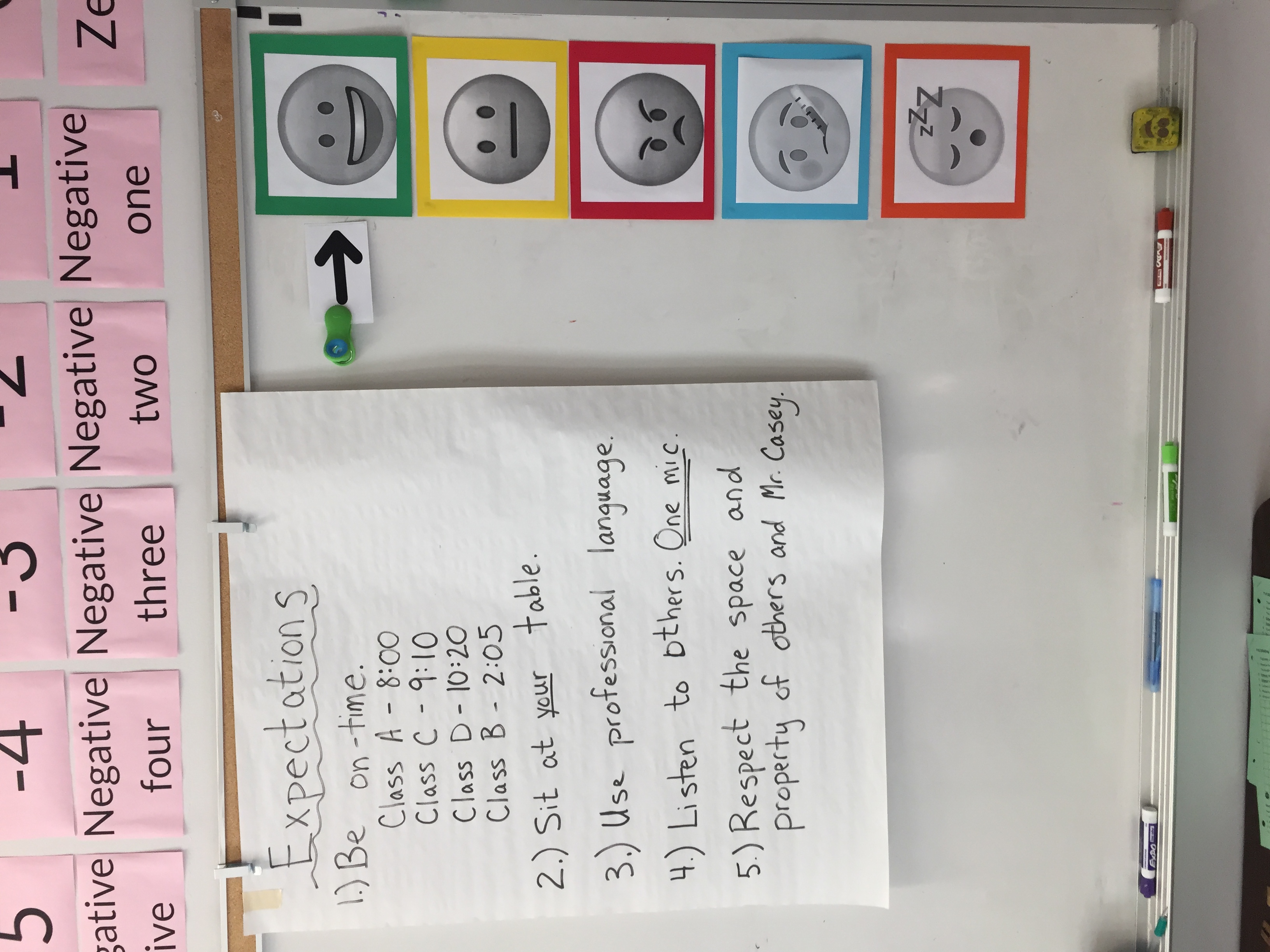
I reflected on the things that I wanted to see more consistently in my class and focused on the positive things I was looking for, avoiding the negatives.  For example, instead of saying “don’t throw things”, I wrote “respect the space and property of others”.  These were the five expectations I created:

  1. Be on time.
  2. Sit at your table. 
  3. Use professional language.
  4. Listen to others. One mic.
  5. Respect the space and property of others and Mr. Casey.

Finally, I thought about the ways in which I exert my pre-anger strategies.  As a teacher, I have become skilled at remaining calm even though I am severely frustrated.  Are the students aware that I am feeling frustrated as I go through those steps?  Are they aware that I am getting more frustrated by the moment and their behavior is contributing to the frustration?  How can I be more clear about how I am feeling before I reach step 4 or worse?  I decided to make it as clear as possible.

IMG-0738

Along with my expectations, I plan to post a “mood meter” in the front for all students to see.  My hope is that if students have the information they will be able to make better decisions and lessen the need for pre-anger steps one, two or three.

“Feedback is information that gives the recipient options. What they do with it is their choice. They might accept it now or there might be other things they work on.  People will change when they are ready to change – not when you are ready for them to change!” (Bradford, 2017).

I’ll try it out starting Tuesday when we are back to school.  Wish me luck and feel free to share other expectations/ strategies you use to make things clear for students. Teaching is a process and reflection is key.  We can’t make February less cold or less dark, but we can be clear in what we expect from students.

My challenge for others is to think about the interpersonal cycle in your own life with friends, family members, co-workers, or students.  How can you be more clear about your own needs and motives in order to more meaningfully connect, inspire, and influence those around you?

Reference:

Bradford, D. (2017). Effective feedback and the developmental process.

Living Your Values

After graduate school, my goal was to teach at a school in which I could learn from and observe amazing leadership.  My advisor connected me with San Francisco International High School.  I knew it was an interesting opportunity because the school was committed to educating recent-immigrant students and had a unique model of distributed leadership.  I had met the principal in one my classes and was impressed.

I just started my second year teaching at SFIHS, and I have to say, I am amazed at how much I learned about myself, about teaching, and about leadership in the past year.  My learning did not come from an amazing curriculum or even an amazing principal; it came from the amazing leadership that emanated from all of the staff.  Everyone was a leader that challenged themselves, each other, and the status quo.  We learned together and supported one another in order to create change in our school and in the lives of our students.

This did not happen by accident.  What I admired most about the school is how deeply it lived its values.  Day 1, we teach the students about the values – what they look like, what they sound like, and what they feel like.  Living the school values isn’t an option, it’s what we do.

Almost more importantly, these are the values by which the staff operate as well.  Each staff meeting we start by drawing attention to a few and end every meeting with a process check to see how well we followed the norms.  Did we honor our time and show up to the meeting on time?  Did we assume positive intent even in those with whom we disagree?

The school values hang in every room and are printed on every agenda.  It’s the common language we all speak, even as students arrive from different countries with little to no English.  We learn together, we act with empathy, we challenge ourselves, and we create change.  These values define us and our students.  They drive us in our work and keep us in check when the workload is large and time is limited.

  1. Learn Together 
    a.) Celebrate success and opportunities for growth.
    b.) Seek resolution.
    c.) Be open to outcome, not attached to outcome.
    d.) Be fully present. Honor our time.

2. Act with Empathy
a.) Assume positive intent.
b.) Communicate honestly about your needs and perspective.
c.) Seek to understand others’ needs and perspective.

3. Challenge Yourself
a.) Take risks and allow yourself and others to grow and learn.
b.) Step up; step back.

4. Create Change

I’m curious what values drive your work or your school?  Do you have a common language and method to keep yourself and your school’s many personalities in check?  Define your values and create a school where everyone leads and grows together.